

Stuffed Pizza Bagels
Ingredients
For the Filling
For the Topping and Assembly

Method
-
Preheat the oven to 350 F. To a mixing bowl, combine all of the ingredients for the filling. Mix or whisk very well until light and fluffy. Transfer contents to a large ziploc baggie and set aside until ready to use.
-
In a shallow bowl, add the melted ghee, egg, condensed milk, milk, and a salt of salt. Whisk very well to combine.
-
Using a bread knife, cut 6 slices into the bagel, being careful not to slice all the way through. Cut a hole at the tip of the ziploc baggie, and pipe the filling evenly into the slits of the bagels.
-
Carefully dip the bagel into the ghee coating first on the filling side, then flipping to coat the bottom. You want to ensure the whole bagel is coated. Place on a parchment lined baking tray, and sprinkle tops of bagels with mozzarella cheese, cooked pepperoni and dried parsley. Bake for 18-20 mins, then broil for 1-2 mins on low at the end if needed to brown the cheese. Let it cool for 10 mins before serving warm.
Feel like trying out other recipes?
-

Mains Snacks
Butter Chicken Fries
Featured
in the recipe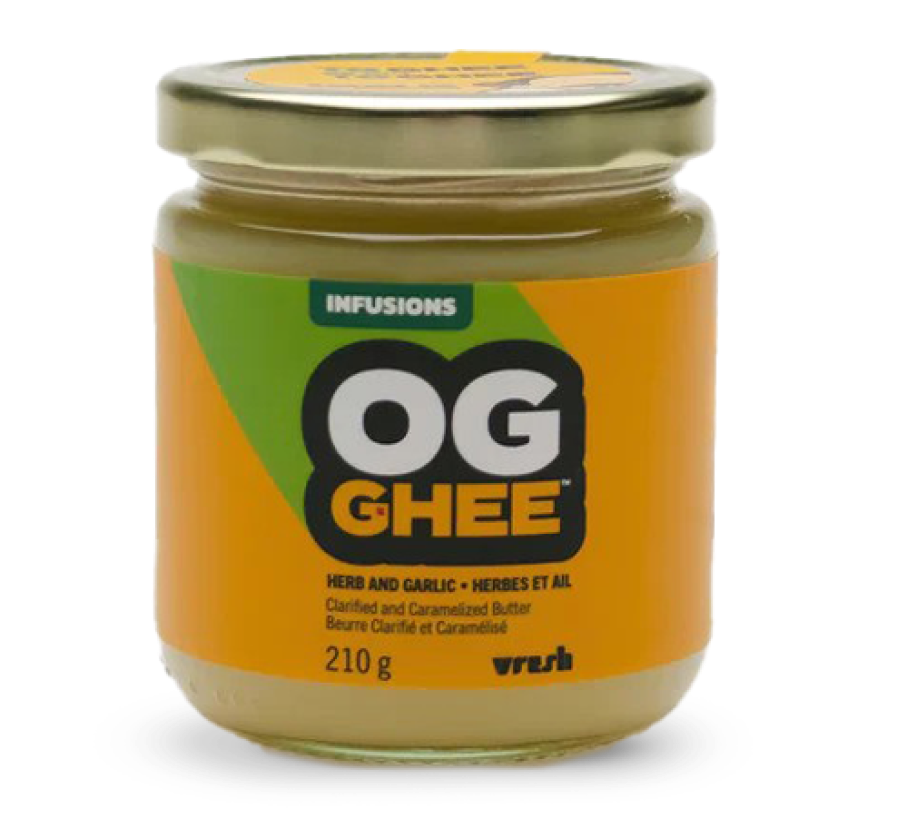


SEE HOW WE COMPARE


Shelf life
2+ years
Storage
Room temperature
Lactose / Casein / Whey
No
Processed Seed Oil
No
Smoke-point
485°F


Shelf life:2-3 months
Storage:Fridge
Lactose / Casein / Whey:Yes
Processed Seed Oil:No
Smoke-point:350°F


Shelf life:1-2 years
Storage:Room temperature
Lactose / Casein / Whey:No
Processed Seed Oil:No
Smoke-point:375°F


Shelf life:1 year
Storage:Room temperature
Lactose / Casein / Whey:No
Processed Seed Oil:Yes
Smoke-point:425°F
You have questions? We have answers
What is ghee?
The result is a golden, caramelly cooking oil that can be used in a multitude of ways!
How do I store my Ghee?
Refrigeration won't harm your ghee, but it isn't necessary. Ghee stored in the fridge will have a firmer texture, while storing it at room temperature keeps it soft, spreadable, and ready to use whenever you need it.
Can I replace Ghee for Butter in my baking recipes?
Is Ghee healthier than butter?
From a nutrition stand-point, the free fatty acid profile, calorie count, vitamins and mineral profiles are nearly identical. The only real ‘health benefit’ comes to those who have traditional dairy allergies (lactose, casein, whey) and cannot consume those commonly found components in butter - as they are filtered out in ghee.
Lastly, cooking at high temperatures with butter leads to milk solids burning, which can be unhealthy in the long term with prolonged use. Ghee’s higher smoke point (485F) makes cooking with ghee a lot easier and healthier.
Why should I buy OG Ghee over others?
What is the real difference here (isn’t all ghee the same?):
We disagree wholeheartedly.
Ghee is a type of clarified butter that is heated past the point of clarification until it caramelizes, giving it a brown buttery, nutty, rounded flavour profile. Most brands in North America stop their cooking process at clarification, often making an undercooked ghee that smells and tastes milk/ raw.
OG GHEE is well caramelized making it a completely different flavour profile to almost every single ghee product on the market. This recipe was formulated through the founders experience of cooking with his mother during his childhood.
The founder’s unique perspective of being a south Asian immigrant, brings authenticity and legitimacy to this product, when most other brands of “premium” ghee are founded by folks with no traditional ties and upbringing in the culture.
When you compare OG Ghee to other low-cost value brands, there really is no competition at all. The value brands are lackluster in flavour profile, visually unappealing with their semi-solid, semi liquid texture, and are packaged in the worst possible format – plastic jars.
When will my product be ready for pick-up?
We are incredibly grateful for the support of our local community over the years. As OG Ghee has grown, we found it increasingly challenging to manage local fulfillment while also focusing on scaling the business. While it wasn't an easy decision, it allows us to better serve our customers and continue building the brand for the long term.
Thank you for your understanding and for being part of the OG Ghee journey.
Free shipping?
Where do you source your Butter?
Our company’s core philosophy is sourcing our ingredients domestically, and therefore supporting the world-renowned Canadian dairy industry. Canadian Dairy is some of the best in the world. Not many people are aware of supplement/medication use in dairy, and automatically assume that because something is not organic, it is filled with hormones and antibiotics.
We work with family owned creameries who source their cream from small-medium sized dairy farmers across the country, ensuring a high quality benchmark, and minimal industrial optimization.
Is OG GHEE Organic?
The rest of our OG GHEE lineup is made with conventional, 100% Canadian butter certified by the Dairy Farmers of Canada. While we remain committed to expanding our organic offerings where it makes sense, certified organic Canadian dairy is currently at a 10-year high in price. Producing our full range with organic Canadian butter would result in high retail prices making our brand less accessible to our customers.
We are committed to using Canadian butter whether conventional, organic, or grass-fed, and producing our products here in Canada.
If it’s not Organic, doesn’t Dairy contain hormones ?
It is good to note that a lot of media claims regarding hormones and antibiotics are true for the United States of America, and people often mistake that for the same in Canada. It is NOT the case for Canada at all - quite the opposite. Our agricultural programs and requirements are FAR superior to those of our neighbours down south.
Here are some recent articles and notes on antibiotics and hormone use in dairy cattle:
Doesn’t Conventional Dairy contain GMOs?
There are some crop cuttings that may contain GMOs (alfalfa, corn stalks etc) that are used in the feed, but it is important to know that any claims of GMO components being found in milk are FALSE. GMOs have never been detected in dairy, even if they are used in cattle feed. At the best, microscopic fragments of this (which do not constitute an organism) have been detected in negligible quantities. Here are some third party, and science supported articles on GMOs in Milk/Dairy products.
Is OG GHEE Grass fed?
Supporting Canadian dairy farmers has always been at the heart of OG Ghee. As we continue to grow, we'd love to introduce more grass-fed products made with butter from Canadian farms we know and trust. Because Canadian pasture grass-fed butter is produced in limited quantities, expanding these offerings takes time—but we're committed to growing alongside the farmers who share our values.
Can’t we get Grass-Fed Butter from abroad?
We currently source from small-medium, family owned creameries who source their dairy from local dairy co-operatives. Most cattle in local dairy co-operatives are pasture raised (as Canada is blessed with land as a key natural resource) in the late spring summer and early fall), and are supplemented with wheat grass, barley and other forage+silage over the course of the colder months.
Didn’t find your answer ?
contact us


